Showing posts with label #ada anniversary. Show all posts

Saturday, July 24, 2010

Let the Festivities begin

The 20th Anniversary of ADA Celebrations began this past Friday in Washington D.C.  Here is the transcript from the kick-off

Attorney General Eric Holder Speaks at the Department of Justice's ADA 20th Anniversary Commemoration


Washington, D.C. ~ Friday, July 23, 2010

"Thank you, Tom [Perez]. I appreciate your kind words, but I am especially grateful for your committed and passionate leadership of the Civil Rights Division. You and your team have done an outstanding job of revitalizing the Civil Rights Division, and renewing the spirit of the law we’ve gathered here to celebrate.

Today, we commemorate the 20th Anniversary of the Americans with Disabilities Act and the legacy of progress that the ADA helped to create. It’s an honor to celebrate this milestone with so many friends, colleagues, and partners – and with many of the leaders who called for and helped to develop this landmark legislation. In particular, I want to thank today’s panelists – a group of advocates who were instrumental in the ADA’s creation and implementation. Thank you all for being here and for sharing your unique experiences and perspectives with us.

I’m also pleased that we are joined by three former leaders of the Department’s Civil Right Division: Steve Pollak, John Dunne, and Jim Turner. And I’m glad to welcome two members of our extended DOJ family: Cheryl Sensenbrenner and Ginny Thornburgh.

I’m also grateful that we are joined by Tony Coelho – a good friend, a long-time advocate for equal opportunity, and a principal author of the ADA. And it’s a special privilege to welcome back to this Department one of my predecessors, my first boss as a lawyer – and, as many of you will remember, one of the ADA’s greatest champions – Attorney General Dick Thornburgh.

In July of 1990, Attorney General Thornburgh said that the ADA’s enactment amounted to “another emancipation . . . one more opportunity to further guarantee equal protection under the law for every citizen of this nation.”

With those wonderful words – and guided by that vision – he set the tone for all that would come. Over the past two decades, the ADA helped create revolutionary improvements in the lives of Americans with disabilities. But just as important, the ADA helped improve our society’s understanding of what Americans with disabilities could accomplish when given the chance to participate on equal terms. The work of the Justice Department – the work done by many of you – helped to drive this progress.

In the 1990s, the Department compelled facilities in every corner of America to provide access to people with disabilities; tackled HIV/AIDS discrimination head on; secured full health-care access for deaf Americans and others suffering from hearing loss; accommodated children with disabilities in child care programs; and agreed with the Olympic Games Committee to ensure that sports venues under construction for the 1996 Olympics and Paralympics in Atlanta were fully accessible to fans with disabilities.

These were just a few of many breakthroughs that helped to rewrite legal paradigms, enlighten attitudes, and change lives. These actions were also a model for the aggressive – and appropriate – enforcement of the ADA.

In July of 2010, I’m pleased to report that the Justice Department has returned to this model. At every level of our work – and in cooperation with our partners across the Administration – we have placed a renewed focus on enforcing the ADA. And we’re seeing results.

Our Civil Rights Division is leading this work, and – in recent months – has settled several lawsuits alleging egregious discrimination against people with disabilities. The Department has renewed its commitment to the aggressive enforcement of the Supreme Court’s landmark decision in Olmstead – recognizing the right of Americans with disabilities to access the care and services they need in their own homes and communities – with suits against three states and participation in suits against another eight.

We’re also working hard to ensure that the ADA keeps up with technological advances that were – quite simply – unimaginable 20 years ago. Just as these quantum leaps can help all of us, they can also set us back – if regulations are not updated or compliance codes become too confusing to implement. We won’t let that happen. To avoid this, the Department will soon publish four advanced notices of proposed rulemaking regarding accessibility requirements for websites, movies, equipment and furniture, and 911 call-taking technologies.

And because, at its core, the ADA is about ensuring that all Americans can participate fully in our democracy, we are taking meaningful steps to offer fully accessible voter registration services at federal agencies, as intended by the National Voter Registration Act.

But our ongoing enforcement efforts extend – as they should – far beyond lawsuits and settlements. The last two decades have taught us that when the ADA is well understood, its provisions are almost invariably well executed. That’s why – to expand the ADA’s reach and to save scarce resources – we’ve launched multiple educational outreach initiatives. In communities across the country, programs such as Project Civic Access, the ADA Mediation Program, and the Department's Technical Assistance Program are making a difference.

The Department’s leading role in enforcing the ADA – and our obligation as a federal agency that employs more than 100,000 people – carries an additional, and very solemn, responsibility: to make sure that our own house is in order… and open to all qualified candidates with disabilities.

We are not yet where we want to be on this front. Put bluntly, we do not have sufficient numbers of people with disabilities who serve as our colleagues in this great agency. But the Justice Department is taking bold steps to ensure that opportunities to serve and thrive here are accessible to every qualified candidate and employee. The Attorney General’s Committee on the Employment of Persons with Disabilities continues to advise me on the best ways to incorporate persons with disabilities into the recruitment, hiring, retention, accommodation, and promotion practices of the Department. And I am proud to announce that, as part of our new Diversity Management Plan, there is now a vacancy – to be filled within several weeks – for a critical new position within the Department: a Special Assistant for Disability Resources.

I am firmly committed to holding the Department’s senior leadership accountable for encouraging the contributions of employees with disabilities, and working to attract qualified candidates with disabilities. This is a top objective of mine – and it must be our shared priority.


As Attorney General Thornburgh put it in 1990, “Each time civil rights are enlarged in our country, they extend over the whole of our society.

“So,” he added, “do not let this bright moment in American history escape you.”

Twenty years later, we must renew our commitment to seize “this bright moment” for our fellow citizens with disabilities and also for our nation. History, again, is calling us. And together, once more, the Justice Department will lead through its work, enrich our nation, and help to fulfill the promise of equal justice, and equal opportunity, for all. These are our goals; this is our responsibility.


Thank you."

Monday, July 19, 2010

What do I think of the ADA...as an architect?


.
Thank you to Abadi Accessibility News for asking me to weigh in with my opinion as we approach the 20th Anniversary of the Americans with Disabilities Act. My name is Bob Borson and I can typically be found at the helm of my own blog, Life of an Architect .

On July 26, 1990, the Americans with Disabilities Act (ADA) was signed into law by then President George. H. W. Bush. It was a momentous occasion and it would change the lives of millions of people, mostly for the better. So here we are 20 years later, well into living and working with the rules and regulations associated with the ADA, but how are we as architects doing implementing these rules? As architects we are probably doing okay because you can't work on a project without implementing the requirements of the ADA. For example, this act was signed into law before I even graduated from college so it has existed all of my professional life. That having been said, how are our clients doing with it and are we helping them?

On occasion, when I tell people that some portion of their project doesn't currently meet code or when I try and explain why the bathrooms are as large as I have shown them, I get puzzled, sometimes irritated responses:

Client: "I was in a restaurant the other day and their toilet room wasn't anywhere near this big."
Me: "Well that doesn't make it right, besides, it is possible that their toilet rooms were permitted before ADA was a requirement."
Client: "And why is that space behind the cashier so large - make it smaller.."
Me: "I can't, that is another ADA requirement. Someone who works back there might be in a wheelchair and they need to be able to turn around and maneuver properly."
Client: "It's too big, I just won't hire someone in a wheelchair."
Me: "It's not called the Americans in Wheelchairs Act, there are other disabilities. You do realize that you are now practicing a type of discrimination and trying to break a federal law?"
Client: "No one else seems to have to do it...now whose being discriminated against?"

I am embarrassed to have to say that I have had this exact conversation or some form just like it several times and I am always shocked that people don't even realize that they are practicing discrimination. I like to think I have smart clients but I have had a few tell me (after I pointed out what they were asking for) tell me that they don't discriminate, that they like people from all races and backgrounds.

Errr...that would be racism and something entirely different. Holy gorilla's armpit - you have got to be kidding me.........

I have to be honest with you, I mostly do residential work and my knowledge of the intricacies of the rules and regulations associated with the ADA are pedestrian at best. I can handle looking things up in the rule book and coming to my own conclusions but what it really comes down to is having a Registered Accessibility Specialist, or RAS, who is there to help guide you. When I start a project, and I try to sit down with all the people who will be working with me and I have a conversation about how we are all on the same team and that we all have the same goals. See, the very nature of how most contracts are set up, adversarial relationships between architect and contractor are established from the very beginning. Another relationship that can be a bit...well maybe not adversarial but difficult at times is between the architect and their RAS. Sometimes, and I mean this with begrudging respect, RAS tend to be rule followers of the highest order. This "rule following" mentality can actually serve the architect well when trying to navigate the labyrinth that is the ADA rulebook. But I am not interested in just rule followers, I want my RAS to interpret how the rules might actually apply specifically to my project. And that's where my particular RAS consultant specialist comes in.

When I was asked to write this post, I was more than happy to do it. The type of RAS consultant I like to work with typically has an architectural background. Having a RAS who thinks like an architect while interpreting the rules and regulations associated with ADA, brings me that much closer to achieving a successful project while getting everyone working on the project on the same side and with the same ultimate goal. I don't think that some people think about the type of role that a RAS can perform - if you get the right one. It is my intention to go beyond just "doing the right thing", disabled persons should have their actions and challenges taken into consideration. Trying to be a rule breaker, or even a rule bender, holds no allure for me as a architect and designer. But just as I have to interpret the projects programs, I want a RAS consultant who will help me work within the guidelines established and to achieve all our common goals - a happy client. Incorporating ADA requirements into your projects is an indication on how far we as a society have come, how inclusive we can be. It should be more about what we can do, not what we have to do.

Sunday, July 11, 2010

"I was for the war before I was against it..."

In the ADAAG there are rules that might appear to be inconsistent.  Sometimes there are rules for the same space or fixture that have different requirements depending on where they are found.  Here are a few examples:

Grab Bars

Grab bars at water closets that are not in a stall follow fig. 29, which specifies a minimum of 54" from the back wall to the edge of the grab bar


But for the same grab bar that is found in a stall or toilet compartment, the length required is 52" minimum per figure 30d.


Sinks and lavatories

A sink is a plumbing fixture not found in a restroom or used for other things than washing hands, whereas a lavatory is typically found in a restroom and is only used to wash hands.  The knee space requirements for each is slightly different.  For a "sink" the knee space requirement is 30" wide and 27" tall to the underside of the apron. 


At a lavatory, though, the knee space requirement changes to 29" below the apron per Fig. 31


Counters

Depending on where you find a "counter" there is a different height requirement.  If the counter has a sink, then the height is 34" high maximum. 


There are also knee space requirements that are not provided in the picture above, but the height of the counter was acceptable.

A transaction counter at a retail store, or a beverage counter at a restaurant or a counter at an eating establishment or bar, can be placed at 36" maximum above the finished floor.


Counters located at employee work areas are not required to adhere to the guidelines.  These are exempted except for the ability to approach the work area, enter it, turn around and exit.  The elements within the work area are not required to comply.
It's sometimes difficult to be cognisant of all the nuances of the Guidelines, but when designing, it is important to note, that not all requirements are created equal and it does depend on how the elements are used on whether or not they have dfferent rules and standards.

Sunday, June 20, 2010

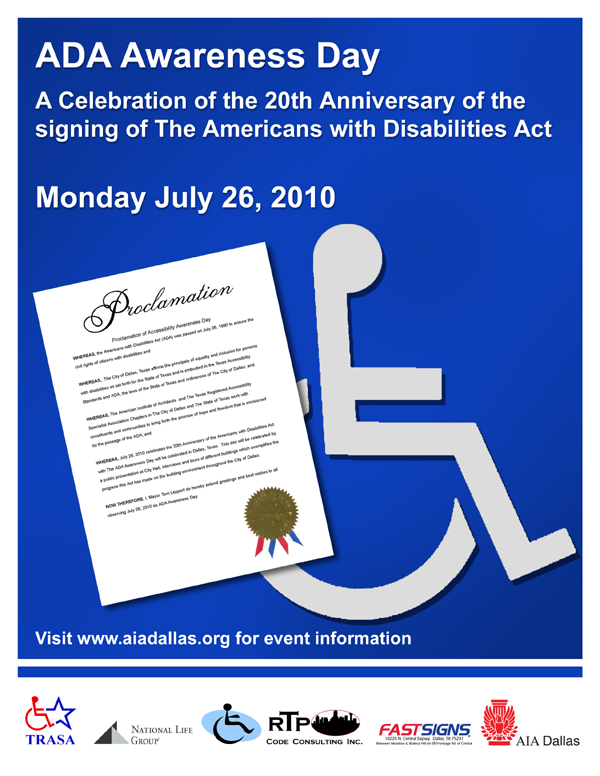
ADA Awareness Day in Dallas, Texas


ADA Awareness Day
Celebrating the 20th Anniversary of the Americans with Disabilities Act
Local architects, disability advocates and City officials are collaborating to celebrate the 20th anniversary of the Americans with Disabilities Act (ADA) civil rights law. 
The Act was signed into law by George Bush on July 26, 1990.  July 26. 2010 has been proclaimed by Mayor Tom Leppert as ADA Awareness day in the City of Dallas and ADA Celebration Day by Mayor Phil Dyer in the City of Plano .
Sponsored by

HERO                    FRIEND

rtp      bobrick     apple    bda   access logo

IN-KIND                                                                  ORGANIZERS
fast signs                   trasa.jpg       aia_logo.jpg                        

Proclamation Announcement with Kent Waldrep Keynote speaker
10:00 Dallas City Hall

20
Kent Waldrep will honor us with his participation as our Kick-off speaker to the ADA Awareness Day in Dallas.  He will speak at the Dallas City Hall at 10:00 a.m. on July 26th 2010.  His inspiring journey will give us an idea of how the ADA has benefited our country and the disabled community.

DARS will also be present to discuss what services they provide to the disabled community.

This event is open to the public.

For more information contact Marcela Abadi Rhoads at 214-403-8714 or marhoads@abadiaccess.com

12:00 at 4306 Capitol Avenue, Dallas, 75204

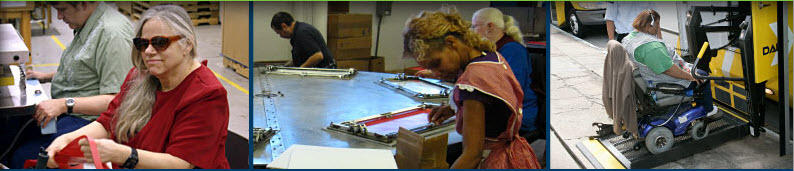
 Founded in 1931, the Dallas Lighthouse for the Blind, a George Dahl architect designed historic building, focuses on improving and enhancing the lives and opportunities of the visually impaired in North Texas.  Their guiding principle is the belief that with knowledge, training and motivation, people who are visually impaired can succeed and thrive in any workplace, live productive and meaningful lives, and be important contributors to their communities.

blind

By providing jobs, job training and offering community services, the Lighthouse strives to empower and encourage its clients toward living independently. 
The Lighthouse's Industrial and Sewing Centers, where more than 150 people are employed, and the Technology Lab, which offers adaptive business skills training to provide enhanced upward mobility opportunities for employment in a variety of office environments,  will be in full operation for this 30-minute guided tour.  Find out how the Lighthouse is making a real difference in our community and how you can help.   This tour is open to the general public, and reservations are not required, but a response to ensure your space on the tour would be appreciated.
For additional information, call Jo Baker at 214-821-2375, ext. 116.

Texas Discovery Gardens: A Case Study
 6:00 p.m. At the Texas Discovery Gardens in Fair Park
tdg

Texas Discovery Gardens, a butterfly exhibit at Fair Park, was renovated by Oglesby Greene Architects.  The original building is historic from the 1936 Centennial Exposition, as the House of Horticulture.  What is now the Butterfly House was originally a conservatory.  An addition was completed in 1971.  The historic building was not originally accessible and with the remodel it was updated to meet the State and Federal requirements in a very sensitive and effective way.   The tour will begin at 6:00 p.m. and will be led by the project architect and accessibility inspector. 

This tour will be $10 for AIA and TRASA member and $20 for non-members and it is worth one hour of barrier free HSW CEU.  RSVP to the AIA since there is a limited number of spots.

Please RSVP to the AIA at 214.742.3242 or info@aiadallas.org


City of Plano Council Meeting and Proclamation Announcement
7:00 p.m. at the City of Plano Council Chamber

City of Plano joins communities across the country in recognizing the 20th anniversary of the signing of the Americans with Disabilities Act into legislation. The City is proclaiming July 26 as an annual ADA Celebration Day in the City of Plano. The Honorable Mayor Phil Dyer will present the proclamation during the regular city council meeting on Monday, July 26.  Kent Waldrep will be a distinguished guest partaking in the proclamation event.
Plano Proclamation Presentation
Monday, July 26, 7 p.m.
Plano Municipal Center,
1520 K Avenue
Plano, Texas 75023


Sponsorship opportunities still available.

Our hope is to explore the effect of the act on the built environment as well as those whose lives have been enhanced by improved access to jobs, education, recreation, services and goods previously denied them by physical barriers or discrimination. 

This is a day for awareness and for celebration of the elimination of architectural and cultural barriers in our society