Showing posts with label blind. Show all posts

Tuesday, March 29, 2011

How do architects deal with "head knockers" under stairs?


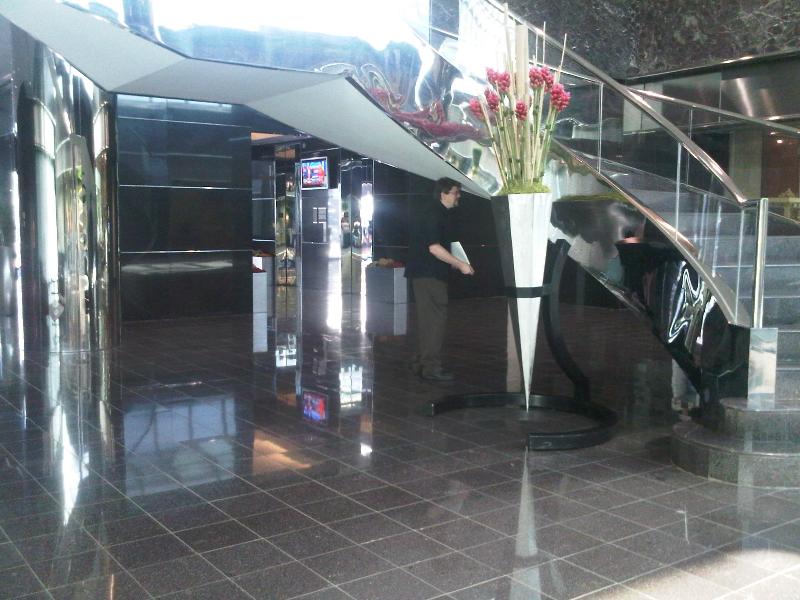
A common design feature in many commercial lobbies are grand stair cases.  Many times, the grand stair is open on all sides, to feature its structural beauty.  Grand stairs are typically curved or done in a way that it gives the lobby a sense of elegance.
One thing architects and designers don’t think about is what happens with their visually impaired patrons who will not see the back of the stair?  The open structure below the stair is a design feature, but because a blind person who uses a cane to find their way around will only detect an object that is mounted lower than 27” , the stair treads that are above 27” and below 80” will be a hazard since they are not detectable. 

A client of mine called them “head knockers”.  I thought that was pretty appropriate.  Architects and designers are problem solvers. They love a challenge, especially when it comes to being creative with a solution to a possible design issue.  There are many ways that I’ve seen these head knockers get resolved.  Below are just a few of the one’s that I have seen. 


This stair does not have a cane detection element, so it is a hazard to my poor husband, oops, I mean poor man that is running into it

Some designers use planters

Some don't want to call attention to the cane detection barrier rail , so they use a curb instead.  This one is 4" tall.  Although this is technically cane detectable it is not detectable by distracted people who could trip on it

Putting furniture is not a good solution, since it can be moved

At a retail store, placing the back of the stair where there is no circulation path could work


A simple and elegant rail that mimicks the design of the stair

This one is at the University of North Texas and the rail is a nice green and white which are their school colors.  Very spirited
This was a good attempt with low fixed bench type seating.  The problem with this one is that is still open and able to be accessed by a blind person who would not detect the barriers on either side of the open stair.

In general, this type of issue could be a great opportunity for great designers to solve.....  

Thursday, November 4, 2010

protruding objects - avoiding hazards along the way

When designing for accessibility, we immediately think of the wheelchair users and their needs.  We design the parking, accessible route, ramps and eliminate the architectural barriers that impede the wheelchair access to the building or site. But the ADA involves more than mobility disabilities. The rules that people are not so aware of deal with the visually impaired community. The way we design for the blind and low vision patrons make it easier for way finding and getting around avoiding hazards along the way. 
The new ADA keeps most of these rules intact, except for adopting a new numbering system in the guidelines. The new section for protruding objects will be found in Section 307 Protruding Objects
blind
Protruding Objects
In the 2004 version of the ADAAG, the rules describe objects that protrude onto the circulation path of travel (not the accessible route).  This path is different than an "accessible route". The path of travel is for all pedestrians, regardless of disability. Along the circulation path, there should not be any protrusions that would cause a hazard to people who are visually impaired and wouldn't normally see the protruding object.  These requirements are now found in section 307 (formally 4.4)
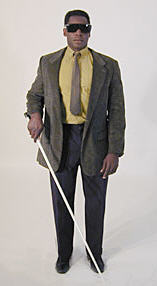
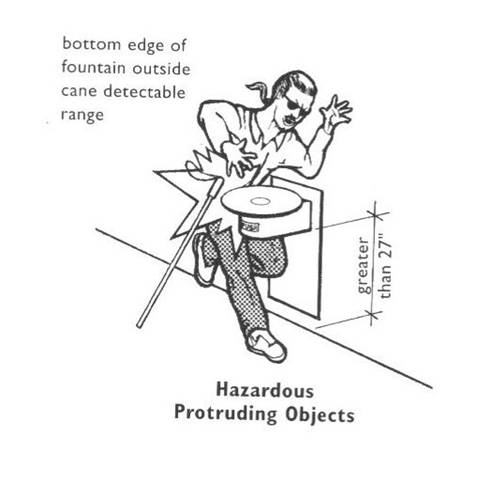
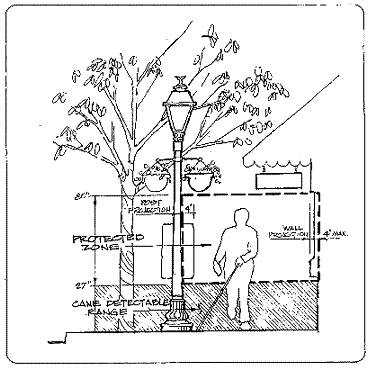
Wall mounted and free standing objects that are mounted above 27" cannot be detected by a person who uses a cane to find their way around. So any object that is mounted on the wall along the circulation path (remember this is a pedestrian route, not a wheel chair route) have to maintain a path free of obstructions
ewcpath
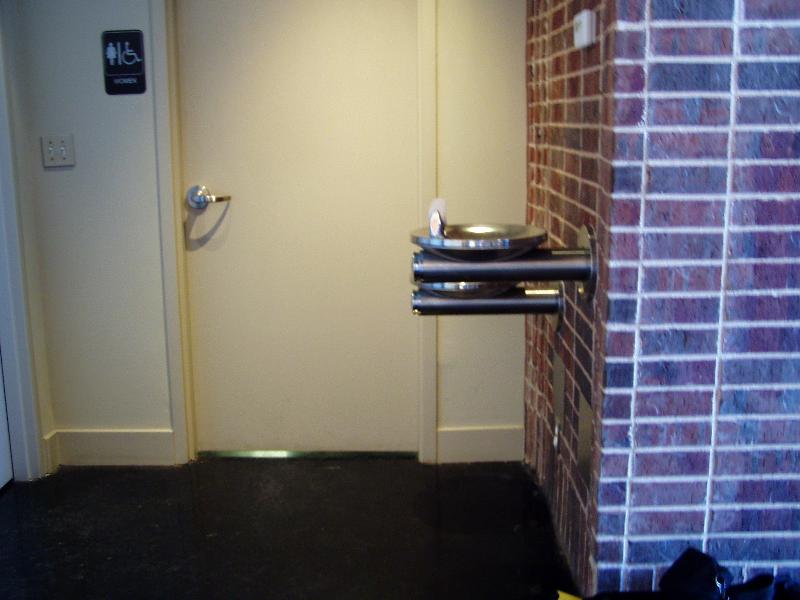
This photo shows a drinking fountain on the way to the restroom and higher than 27" a.f.f. which would be a hazard to a blind person


ewc

A person who is visually impaired will not detect objects that are lower than 80" from the ground.  Objects along the circulation path, such as open stairs, sconces, even branches of a tree, should have some warning at a cane detectable height in front of it in order to warn the visually impaired person that a hazard may be up ahead  

ouch
This open stair is a hazard since there is no way to detect the lower portion. 
safety zone
This graphic shows exterior elements that could become
hazards if they are not cane detectable.


Inspector's Corner
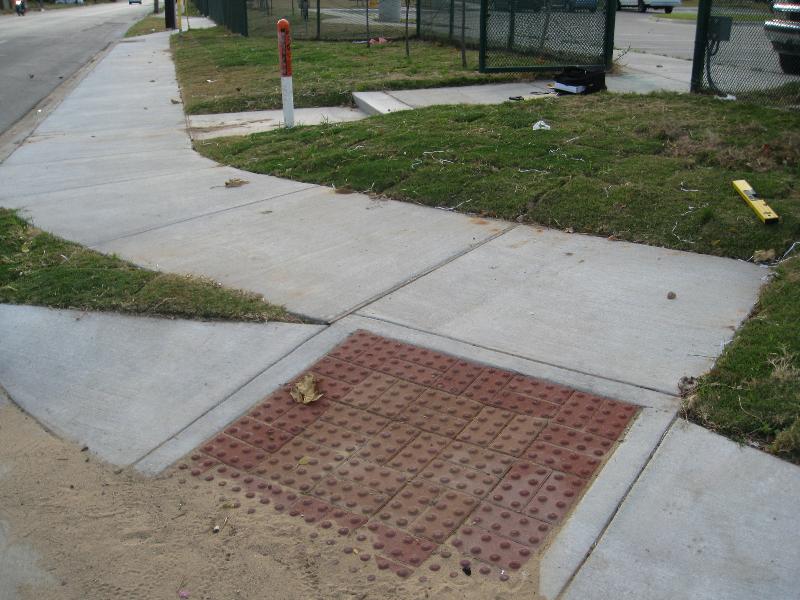
The 2004 version of the ADAAG eliminates the detectable warnings at curb ramps.  No longer will the truncated dome texture and contrasting color will be required within the property line. The Access Board and the Department of Transportation will be developing guidelines for curb ramps in the public right of way.  We will keep you posted.
 Detectable warnings are a controversial topic for architects but also for the disabled community.  Visually impaired people really like detectable warning, like truncated domes, because it helps them with way finding.  However architects and builders get frustrated with all their inconsistencies.  Wheel chair users don't enjoy the high maintenance that it requires at curb ramps.  If the ramp ices over, it can gather dirt,and it is hard to wheel around it.  So even though the detectable warnings at curb ramps were removed, the controversy in the disabled community has not gone away
curbrampdirty
This is an example of how a curb ramp can accumulate dirt and ice so that it can become a hazard more than a help

Wednesday, October 27, 2010

Do you have a personal mountain?

October 27, 2010  was the 6th annual Accessibility Awareness Exercise at the AIA in Dallas, Tx where architects use a wheel chair for one entire day. The idea is that they should "walk in their clients shoes" (pun intended).  Architects are trained to design for the disabled, and make their buildings accessible and Universal, but until they sit in the chair for one day, they probably won't understand fully the impact those pesky circles and knee spaces that they put on their drawings have on the real world.


Every year they have a speaker that inspires us as architects to think about disabilities in a whole different light.  This year's speaker was Walter Patterson.  He is an amazing man who at 18 months contracted polio.  He spoke about his journey from a toddler having to wear braces on his legs, to having to be horizontal on a wheel chair for 24 hrs at a time, to the time he was a teenager and was able to get his driver's license.  Mundane things like these that we may take for granted, but so important to every kid as they grow up.  He shared how he learned to play bass guitar so he could play in a band in high school because he couldn't dance and it was his only way to participate in the social gatherings.  And in college he discovered gymnastics and was a winner in the sport.  But his most amazing achievement with his polio was his trek up Mt. Everest!

Here is Walter as a toddler with his crutches and wheelchair in the back

Here is Walter at Base Camp of Mt.Everest

With his talk, Walter showed us how his disability did not impede his ability to live a full life! 
"Only 1 out of 10 people (abled bodied or not) that made it to base camp go up to  Mt. Evererst!.  And the number one reason why they don't make it is that they never left home"
Walter had a vision and a plan but more than that he had persistence and a great attitude!  He was also humble enough to accept that he would have to be carried part of the time in order to make it in 29 days (otherwise it could have taken twice as long- not that he couldn't have done it)

I read an article on USA Today  last week about a group of blind and visually impaired kids and adults that went hiking down the Grand Canyon. Scary thought!  I can't imagine me as an abled bodied person going hiking down such a rocky place next to an abyss, let alone if I had no sight!  Wow! But that didn't stop them! 


The lesson from all this is that there is no reason not to get to the top of "Your" mountain!  Whatever that barrier or obstacle is for you, these amazing individuals show us that nothing is too difficult to surmount.

Thursday, August 26, 2010

Monet had Cataracts

I love impressionistic paintings. They are a marvel of color, textures and optical illusion! It is like painting the trees and getting the forest….How did the Masters do it? I recently found out that Monet, one of the great impressionistic painters, had cataracts and that is what made him paint the way he did. He had to get close to the canvas in order to paint. He hated his style once his cataracts got worse. He didn’t value its beauty….Thank goodness that others did. We are now lucky to have had him in the world with cataracts and we can enjoy his beautiful work.


On the 20th anniversary of the Americans with Disabilities Act, a group of architects toured the Dallas Lighthouse for the Blind. This is an amazing facility that trains and employs visually impaired people to manufacture many items from eye glass cases, highlighters, and even military shovel carrying fanny packs. It was an “eye-opening” experience (pun intended). These people are truly incredible. They are able to use computers with a software that read them what is on the screen. But the software doesn’t read it like an audio CD that you read for fun….it speed reads. One of the trainees demonstrated the software and he had it read what was on the screen in the speed that he can understand. All I could hear was gibberish….it was reading 120 words a minute…. and he could actually understand it! INCREDIBLE!!!


There is also a software that assists in reading called J.A.W.S.  this makes the text bigger as needed.  We also saw the others at work at sewing machines, assembly lines and their individual stations where they put together all sorts of products that are sold to companies. These people are so good at what they do, that all I could do is just open my mouth and be in awe!!!


The building was also designed for the low vision people that worked there. The door frames were a contrasting color to the doors and walls so that they could “see” that there was a doorway there rather than just a wall of the same color. Their bathrooms had circular mirrors so that they would not think it was a window they were looking through. And many other items such as braille at signs, truncated domes on ramps so they can detect the change in environment, and they even use their sense of smell to move around their space.


That experience really made me think of the disability and how truly remarkable our bodies (and these wonderful people) are that they can adjust to their limitations.
Enhanced by Zemanta